
Ogemaw Parole Versus Probation
Parole begins after a person leaves an MDOC prison under conditions set by the Michigan Parole Board. The person is in the community but remains under Michigan Department of Corrections jurisdiction. Probation is a court sentence. It may follow a jail term, or it may be imposed without any prison term. Ogemaw County has both MDOC supervision and court probation routes, so the word “probation” alone does not identify the right office. The sentence and assigned agency do.
The distinction also changes what counts as proof. An OTIS profile with a current Parolee status and Date Paroled supports prison release plus active supervision. An OTIS Probationer result supports MDOC-managed probation. A monthly reporting instruction from the 82nd District Court points to court probation instead. None of those records means full discharge. Discharge is the end of the agency’s jurisdiction for that sentence.
| Point | Parole | Probation |
|---|---|---|
| How it starts | Release from an MDOC prison after Board action | A sentence ordered by a court |
| Main local route | OTIS and the assigned MDOC field office | OTIS for MDOC probation, or the sentencing court for court probation |
| Release meaning | Out of prison, still under MDOC jurisdiction | May exist with or without a prison release |
| End point | Supervision discharge or sentence discharge | Completion or discharge under the controlling order |
- Parole
- Conditional release from prison while MDOC supervision continues.
- Probation
- A court-ordered sentence served under rules in the community.
- Discharge
- The end of corrections jurisdiction for the sentence shown.
- Absconder
- A person reported as failing to comply with or report for supervision.
Check Ogemaw Supervision Records
The MDOC Offender Tracking Information System, known as OTIS, is the public starting point for a state-supervised person. OTIS covers prisoners, parolees, MDOC probationers, and most discharged people for three years after the latest supervision discharge. It does not cover a person sentenced only to the Ogemaw County Correctional Facility. A missing OTIS result can therefore reflect the wrong system, an older discharge, or a set-aside record. It is not proof that supervision never existed.
- Search by the six-digit MDOC number when it is known. Otherwise, use the full name and narrow the match with age, race, or other reliable identifiers.
- Open the matching profile and read Current Status first. Do not rely on the photo or a single date.
- Review Date Paroled, Supervision Begin, Supervision Discharge, and Assigned Location. A future discharge date is not a completed discharge.
- Contact the assigned office for an important current fact or a suspected supervision error.
- If the sentence was imposed and managed by a local court, check the Ogemaw court record and contact that court instead of treating OTIS as complete.
OTIS filters distinguish Parolee, Probationer, Parole Absconder, and Probation Absconder. The result must be tied to the right person and sentence. A same-name record from another county may be unrelated. When the profile lists an Ogemaw assigned location, the local field team is the direct verification channel. The broader Ogemaw County released-inmate search path explains how to confirm the earlier county custody event before checking supervision.
Note: Read status before dates because eligibility, parole, supervision discharge, and full sentence discharge describe different legal stages.
Ogemaw Supervision Office Details
The official Ogemaw County Probation and Parole page identifies Region 3 Supervisor Ken Werner, agents Diane Wahl at extension 1, Tara Rose at extension 2, Rebecca Bailey at extension 3, and secretary Michelle Smith at extension 4. It lists a more specific number than the county’s general directory. No universal check-in schedule is published, so call before visiting. An office contact can verify where a state-supervised person should direct a current question, but staff may limit what they disclose about another person.
Ogemaw County Parole/Probation
806 West Houghton Avenue, Room 108
West Branch, MI 48661
989-345-5680
County-listed hours: 8:00 a.m. to 5:00 p.m., Monday through Friday
The official local supervision page displays the Ogemaw office and staff route used for a current contact check.
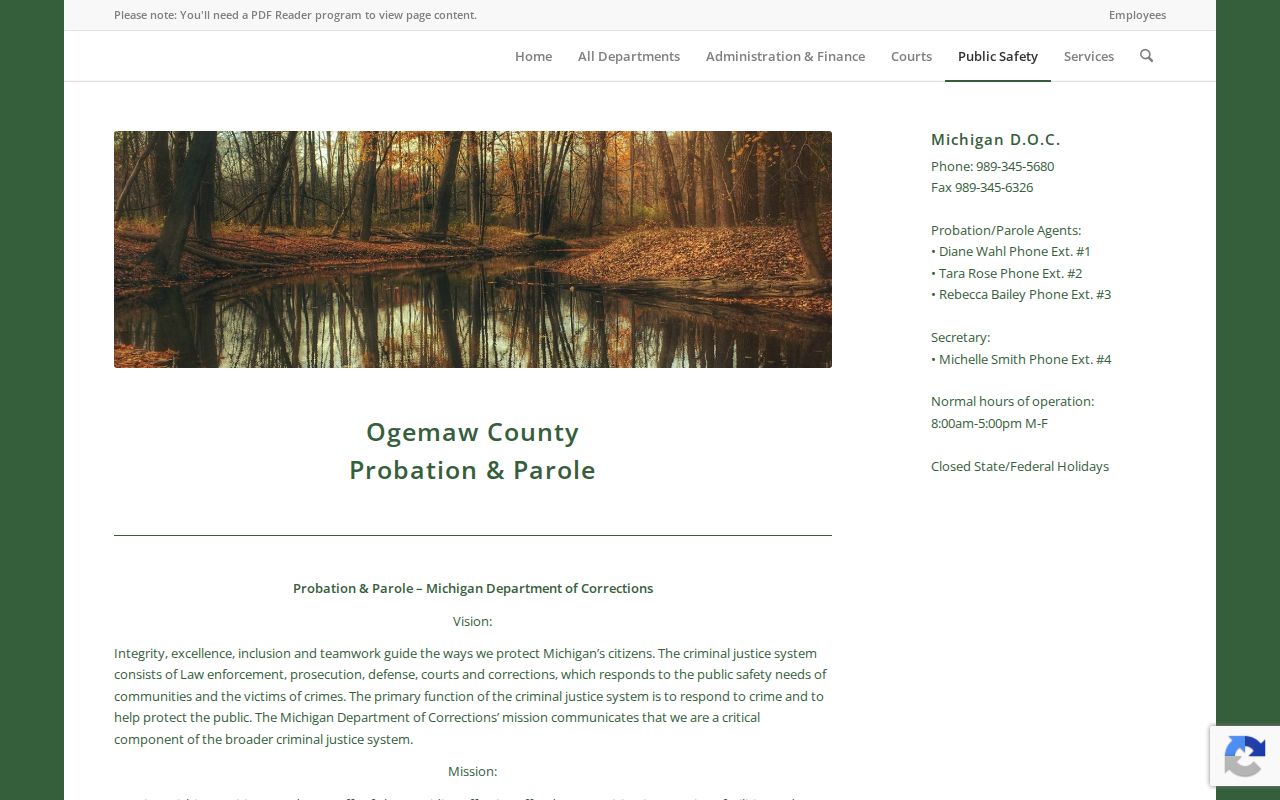
The published extensions make the local page useful after OTIS identifies Ogemaw as the assigned supervision location.
The Michigan Parole Board is the sole paroling authority for MDOC felony prisoners. Board questions can also be directed through the official Parole Board information page. The Board and the field office serve different roles. The Board makes parole decisions; the field office manages supervision once assigned.
Ogemaw Court Probation Route
The 82nd District Court separately publishes a monthly probation check-in route. That detail matters in Ogemaw County because an MDOC field office and a court probation channel operate in the same local system. A person told to report through the court should not be sent to an MDOC agent merely because OTIS includes other probationers. Start with the judgment, probation order, or MiCOURT case events. Then use the office named by that record.
The 82nd Judicial District Court handles district-court probation at 806 West Houghton Avenue and lists 989-345-5040. MiCOURT can show case events and a sentence, but its online display is informational. Obtain the signed order from the court when the exact terms or end date matter. A closed case may explain a disposition without proving the time a person left the jail.
Note: Confirm the office before travel because a court case and an MDOC assignment may use separate reporting channels.
Ogemaw Absconder Status Checks
An absconder is someone reported as failing to comply with or report for supervision. In OTIS, ABSCOND1 identifies a parole absconder sought by MDOC. ABSCOND2 identifies a probation absconder under the sentencing county’s jurisdiction. These labels are not synonyms for discharge. They also do not establish that the person is physically in jail at the moment of the search.
Verify the profile identifiers and read the assigned office before calling. If a current custody event is the concern, Michigan VINE may provide a separate jail or MDOC notice. VINE distinguishes release, transfer, escape, and death. The exact event text matters. An absconder status in OTIS and a VINE custody event answer different questions and may update on different schedules.
Possible violations and their consequences are case-specific. Conditions may address reporting, travel, treatment, contact, or other conduct in the governing order. A field agent, court, or Board may respond under its authority. Public records do not support guessing what action will follow. Use the current agency record and any signed court or Board document.
Note: An absconder label signals a supervision issue, not a verified arrest, new conviction, release, or completed discharge.
Ogemaw Parole Decision Timeline
Parole consideration generally begins about six months before eligibility. Most interviews occur by secure video with a Board member, and most decisions use three-member panels. Eligibility is not a grant. A grant is not physical release. Once granted, the case goes to the Parole Release Unit, and MDOC requires at least 28 days between the release decision and physical release. New misconduct or other adverse information can suspend a grant.
Michigan has no public master calendar for routine parole interviews and no separate public, named result-search tool. Limited public notices cover Lifer Law, commutation, and pardon matters through the public hearing registration page. Quarterly reports are aggregate, not person-level decisions. For an individual, use OTIS plus the Board or assigned office. Date Paroled and a current Parolee status are the public fields that support actual departure from prison.
The Earliest Release Date is different. It marks the point when the Board may obtain jurisdiction under the sentence rules. A denial or deferral can move the process beyond that date. The Maximum Discharge Date is another potential endpoint. None should be turned into a promised pickup date.
Ogemaw Release Reentry Contacts
MDOC Offender Success help is reached through the supervising agent for an eligible person. Research found no authoritative Ogemaw-only reentry organization, so the local Region 3 team is the concrete navigation point. The agent can direct an eligible person to the relevant statewide or regional service based on the supervision plan. That is more reliable than assuming a program serves every released person in Ogemaw County.
The MDOC reentry-services route describes the statewide framework. County-jail release is separate. Someone who served only an Ogemaw jail sentence is not made eligible for an MDOC service merely by being released in Michigan. The release record, judgment, and supervision order show whether MDOC has a role.
The local field team’s three named agents and direct extensions make Ogemaw unusual among counties with only a broad regional contact. Use that detail after OTIS confirms the assigned location. A phone call made before travel can also avoid relying on a staff list that may have changed.
Ogemaw Release IDs and Corrections
MDOC’s Returning Citizen Identification Program works with the Secretary of State and Social Security Administration on identification documents for people leaving state custody. It is a statewide MDOC initiative. It does not prove that Ogemaw County runs the same program for people released only from its jail.
A record error follows another route. Obtain the underlying booking, custody, or release record first. Direct an Ogemaw county-record correction to Sheriff Brian D. Gilbert’s office or through the county FOIA form, while an OTIS supervision error goes to the assigned field office. County staff do not have to create a new summary or answer questions embedded in a records request. Name the existing record and the specific field at issue.
When supervision ends, OTIS may show Supervision Discharge or a Discharged current status. Most public OTIS information remains available for three years after the latest supervision discharge unless another rule changes visibility. Older proof may require the sentencing court or a focused MDOC records request for a releasable discharge order or certificate.