
Ogemaw Projected Versus Actual Release
Michigan OTIS uses the label Earliest Release Date, or ERD. For an indeterminate state-prison sentence, it generally marks the first point when the Michigan Parole Board obtains jurisdiction. It is an eligibility date. The Board may deny or defer parole, and a grant still requires release processing. Date Paroled is the OTIS field tied to actual departure from prison on parole. Maximum Discharge Date is the potential maximum endpoint of the sentence, not a forecast that the person will stay until that day.
County-jail dates follow another record trail. A person awaiting trial at the Ogemaw County Correctional Facility may leave after bond, dismissal, or another court order if no other hold applies. Until that authority exists, there may be no fixed release date. A person serving a county sentence has a judgment, but the jail’s computation and actual release form remain the key records. OTIS excludes people sentenced only to a county jail.
Transfer adds a third outcome. Ogemaw County houses people for other counties and may transfer someone to MDOC, an originating county, or another authority. The date they leave the Ogemaw jail is then a custody-movement date, not a community-release date.
Find Ogemaw County Release Dates
Start with custody type, not a broad name search. The MDOC OTIS search is correct for a person in state-prison jurisdiction. The Ogemaw facility and court records are correct for a jail-only case. Federal and immigration custody use separate systems. A false “not found” result often means the wrong database was used.
- Identify whether the person is held by Ogemaw County, MDOC, another county, BOP, or ICE. Use the most recent custody-movement record when the route is unclear.
- For MDOC, search the six-digit MDOC number when possible. Otherwise, use name plus enough identifiers to avoid a same-name error.
- Read Current Status before reading any date. Prisoner, Parolee, and Discharged each change the meaning of the fields.
- For an Ogemaw jail case, call 989-345-5908 and check the signed court order. Ask whether a date is scheduled and whether another hold controls.
- After the event, confirm physical release with Date Paroled for prison parole or the Ogemaw inmate release form for a county release.
The Ogemaw County release-record path covers the focused county request when no public roster exists. Ask for the admission time, release date and time, release type or authority, custody transfers, and inmate release form. A court order can explain legal authority but does not establish the exact time the person cleared all holds and left custody.
The official OTIS landing and search form show the state route. The current Michigan offender-search page leads into the form shown here.
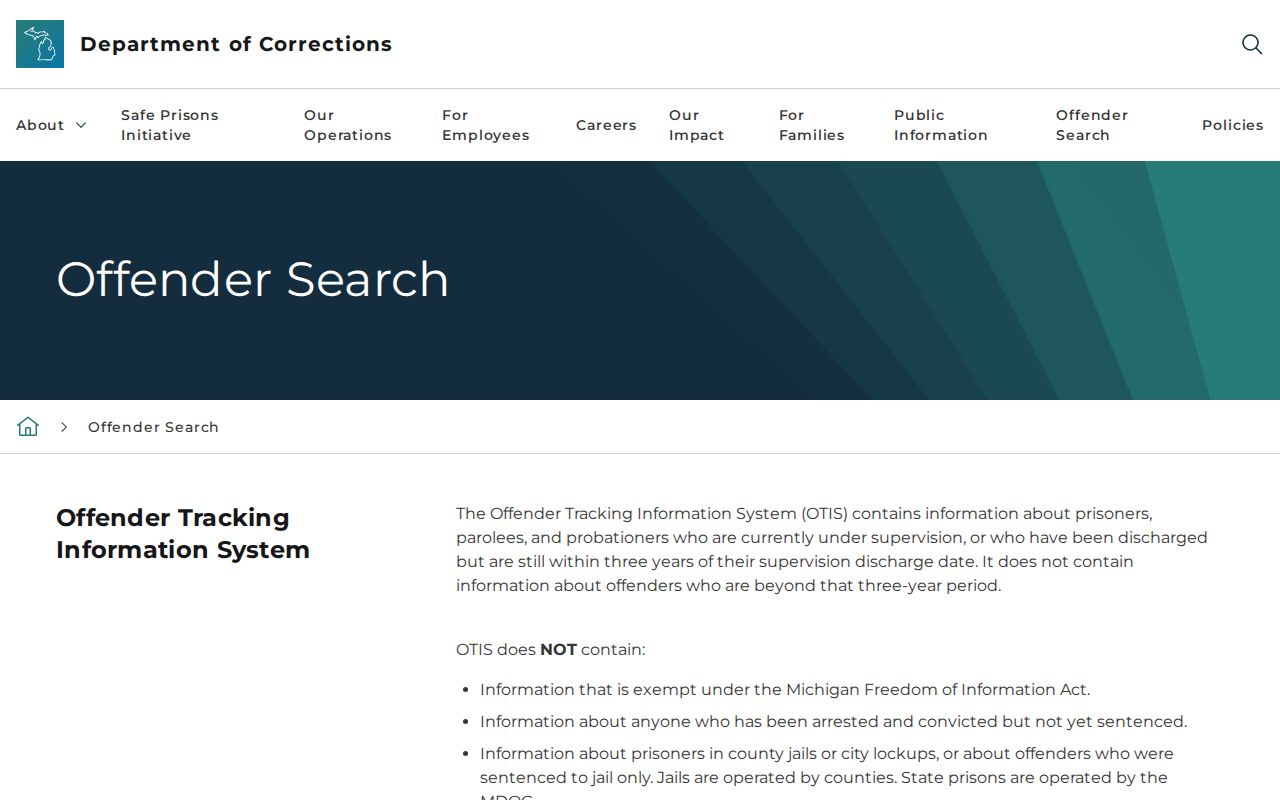
The form’s status filters help separate a current prisoner from a parolee or a recently discharged person, but the opened profile supplies the dates that must be interpreted.
Note: A jail-only Ogemaw sentence will not appear in OTIS merely because the custody occurred in Michigan.
Read Ogemaw OTIS Date Fields
OTIS dates should be read as a sequence. First verify the MDOC number, name, birth date, and physical details. Next read Current Status. Only then compare sentence and supervision fields. A profile can contain several sentence blocks, and an inactive sentence entry does not necessarily describe the person’s overall current status.
| OTIS field | What it supports | What it does not prove |
|---|---|---|
| Earliest Release Date | Earliest Board jurisdiction under the sentence rules | A set exit date or completed release |
| Maximum Discharge Date | Potential maximum sentence endpoint | The expected parole date |
| Date Paroled | Physical departure from prison on parole | End of MDOC supervision |
| Supervision Begin | Start of the supervision period shown | Full discharge |
| Supervision Discharge | Supervision endpoint shown in the profile | Completion if the date is still future |
| Discharge Date and Reason | End of MDOC jurisdiction and stated reason | Community release in every case |
A Discharge Reason matters. Successful completion, maximum discharge, and death are not equivalent events. Death can end custody but must never be described as a return to the community. Parole also differs from discharge because state jurisdiction continues after prison release.
The OTIS field explanations are the source for these date meanings and the three-year public display period after the latest supervision discharge. Their status and date definitions are illustrated below.
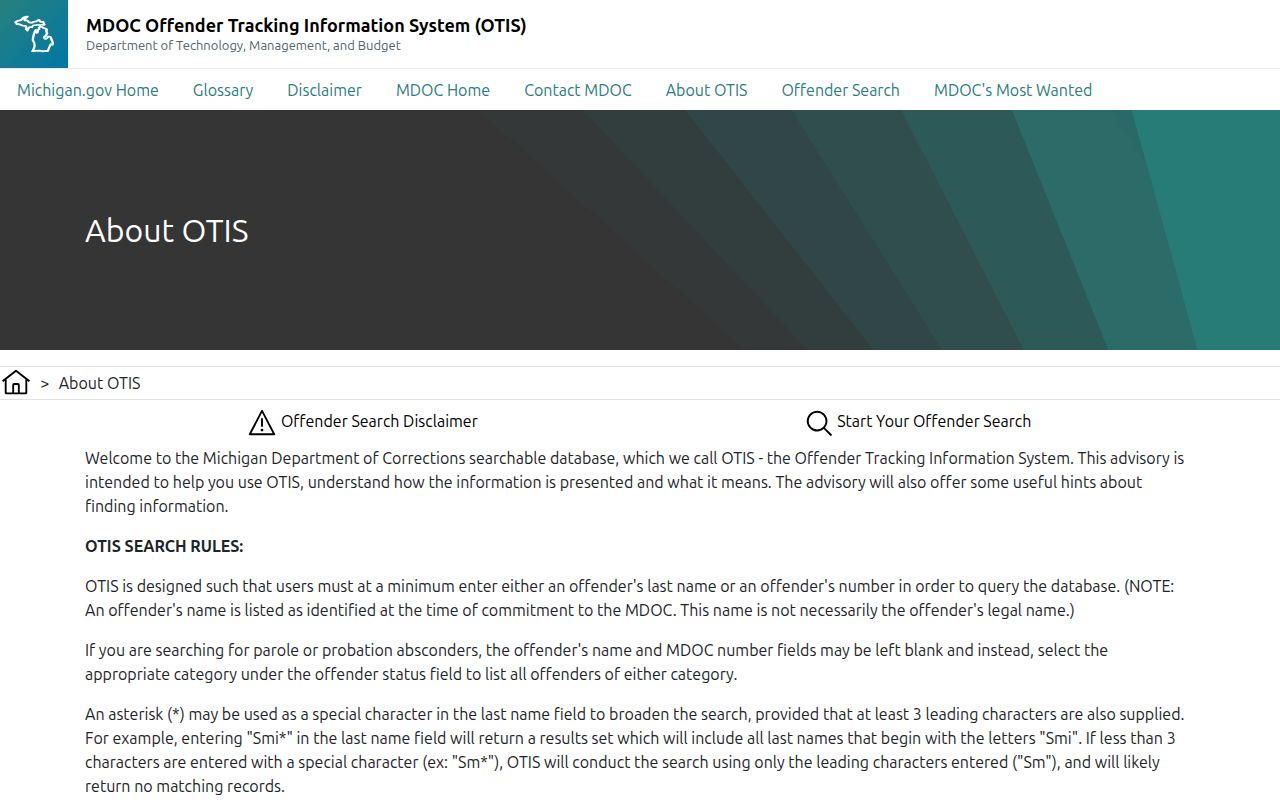
After the public OTIS period, use the sentencing court and a focused MDOC records request rather than treating a missing profile as proof that no sentence or release existed.
Michigan Rules for Ogemaw Dates
Michigan generally uses minimum and maximum terms for an indeterminate sentence. The judgment of sentence drives the calculation. The Board may consider parole at the minimum or ERD, but MCL 791.233 requires reasonable assurance that release will not make the person a menace or public-safety risk. If parole does not occur, the person generally reaches the maximum discharge point, subject to the governing sentence and offense-date rules.
Michigan does not have a general rule that everyone serves about 85 percent. Truth in sentencing requires covered people to serve the full judicial minimum before parole consideration. It applies to specified assaultive crimes committed on or after December 15, 1998, and other covered crimes committed on or after December 15, 2000. No good-time or disciplinary credit shortens that covered minimum.
MCL 800.34 treats disciplinary time as adverse time tied to major misconduct and Board review. It is not earned time subtracted from the minimum. Older offenses may remain subject to good-time or disciplinary-credit rules under MCL 800.33, depending on the offense date and type. Applying a modern rule backward can produce a false date.
Note: Michigan credit law depends on the offense and its date, so a generic percentage can produce a false result.
Why Ogemaw Release Dates Change
A date can move because the legal or custodial facts change. Some changes affect Board eligibility. Others affect actual departure after a decision. A public profile may also change when a corrected court judgment reaches MDOC. The table identifies the source to check instead of guessing at a new date.
| Factor | Possible effect | Verification source |
|---|---|---|
| Consecutive sentences | One term follows another and changes the controlling timeline | Judgment and OTIS sentence blocks |
| Corrected judgment or appeal | Sentence authority or credit may change | Signed court order and updated MDOC record |
| Offense-date credit law | Legacy or truth-in-sentencing rules may differ | Judgment, statute, and MDOC computation |
| Major misconduct | Disciplinary time or adverse Board information may affect review | MDOC record and Board action |
| Board denial or deferral | No release at the ERD | Board action and current OTIS status |
| New hold or detainer | Departure may become transfer rather than community release | Custody-movement and receiving-authority records |
| Suspended grant | Physical release may not occur on the expected schedule | Board or Parole Release Unit record |
A detainer is a request or authority to hold or transfer a person for another jurisdiction. It can block direct release even when one sentence has reached an endpoint. In Ogemaw County, regional housing adds another transfer risk because someone held for another county may return to that county.
Note: A change in the online field should be confirmed against the court or agency record that caused it.
Ogemaw Parole Grant Timing
A Michigan Parole Board grant still leaves a processing period before release. Parole consideration usually begins about six months before eligibility, and interviews generally occur by secure video with a Board member. Most decisions use a three-member panel. When parole is granted, the case goes to the Parole Release Unit. MDOC requires at least 28 days between the Board’s decision and physical release, and new misconduct or adverse information can suspend the grant.
Routine interviews do not appear on a public master calendar. Limited public notices cover Lifer Law, commutation, and pardon matters, while quarterly Board reports provide aggregate grants, denials, and deferrals rather than named results. For one person, the useful chain remains the OTIS profile, Board or assigned-office contact, and then Date Paroled after departure. A release date lookup should not turn a public-hearing notice or aggregate report into an individual result.
A denial receives a reconsideration date. That date is another review point, not a release booking. High or average guideline scores are generally reconsidered yearly after denial, while low scores may be reconsidered at an interval of up to two years. The current Board record controls any individual timeline.
Ogemaw Jail Release Computation
No official Ogemaw local good-time formula, weekend-release rule, fixed release hour, or public date calculator was found. State-prison ERD rules cannot be imported into an Ogemaw County jail sentence. Use the signed judgment, the jail’s sentence computation, and the final inmate release form. If the person is awaiting trial, the court’s bond or release order is part of the chain, but another hold may still prevent departure.
The Ogemaw Corrections page shows that the facility is staffed around the clock. That fact does not mean the public records desk is open at all hours or that release happens at a set hour. Administrative hours are separate. Family or friends planning to meet someone should call the jail before travel rather than infer a time from staffing.
A bond order authorizes release under its terms. It does not prove payment, completion of jail processing, or the absence of another case or detainer. Even a personal-recognizance order does not establish an instant exit. Pair the signed order from the 82nd District Court route with the jail release timestamp when exact proof is needed.
Sheriff Brian D. Gilbert’s office controls the county jail record. When a durable copy is needed, the Ogemaw County FOIA form accepts a focused request for the existing release form and custody-movement entries.
Confirm Ogemaw Physical Release
For an MDOC prisoner, the strongest public sequence is Current Status, Date Paroled, and Assigned Location. For a county detainee, use the Ogemaw inmate release form and custody-movement entries. Michigan VINE can add a timely notice for a county jail or MDOC event, but it does not publish a guaranteed reporting lag or permanent Ogemaw search window.
Register before a possible event when notice matters. Then read the event exactly. Release, transfer, escape, and death describe different outcomes. A transfer notice should lead to the receiving authority, not to a claim that the person entered the community. The Ogemaw VINE inmate check explains the name and ID search plus notification route.
For formal older proof, request a releasable MDOC discharge order, certificate, or time-computation record tied to the six-digit MDOC number. The public PENPACK is not a general option because MDOC limits that packet to recognized authorities for official business. County records remain on a separate schedule, with the inmate jacket retained for release plus ten years under Michigan GS-11.